If you are frustrated with the cost of housing, this newsletter is for you. Over 20 years of observation and 1,000s of hours of research has gone into this edition. Grab your favorite coffee, set aside 20 minutes, and enjoy.
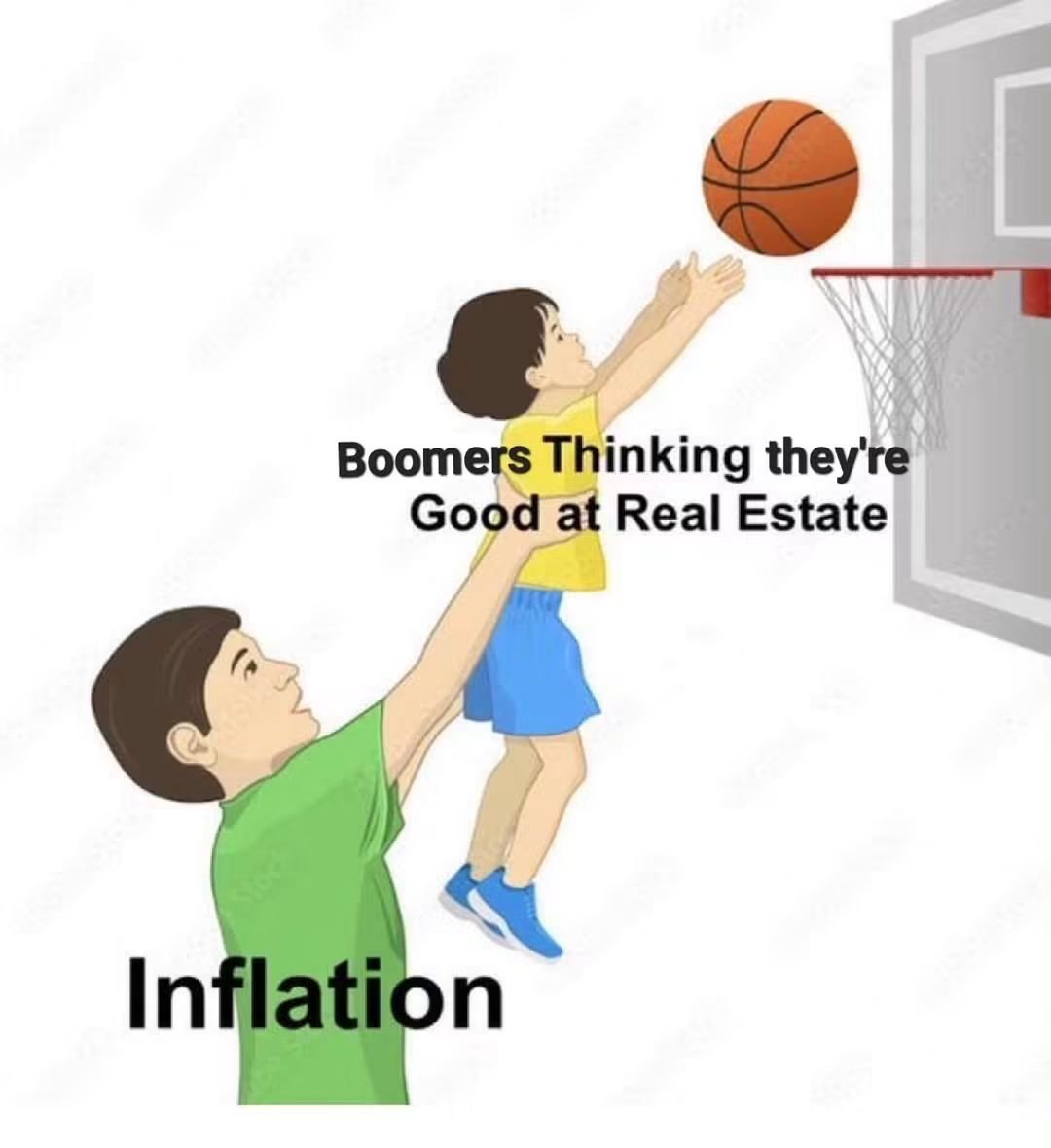
I love this meme from Bonks, it literally made me laugh out loud. But here's the thing: I've seen versions of this meme time and time again. I've created my own versions, such as this:
And this:
The satire is not to belittle the struggles that younger generations face with their cost of living. Rather, this is a way of using humor to cope with the reality that we live with.
Not everyone agrees that housing is expensive.
I have a story that perfectly illustrates that point.
That story represents the moment I began to take destiny into my own hands. The result of which I will share with you at the end.
My debate with two boomers
I lost my temper.
It happens from time to time. But this time I was especially ashamed.
It was 2022. I was out to dinner with two colleagues who happen to be Boomers, born between 1946 and 1964. I'm a millennial.
The first boomer was telling us about his recent move and how he sold his previous home for a huge profit and bought a new one.
I had too many beers to keep my mouth shut.
"You know, you didn't actually gain anything." I said.
"Yes I did. I made over $200,000." He replied.
Ugh. Here we go.
"It's a misconception that you made any money," I continued, "Because you have to roll over that equity into your next home which is equally more expensive."
The point was falling mute on them.
"No, he is ahead." The second boomer chimes in.
"Yeah, good thing I bought back in 2017." The first adds.
I could feel my blood growing hot.
"You do understand that inflation is responsible for raising the price of all housing, your home didn't change; the money did." I said.
"I made a good investment. You can, too, if you buy a house." The boomer rebuted.
F*ck. I've lost it now.
"Now, hold on a second." I said sharply, "I've already bought and sold multiple homes. My equity rose, as well. But that's not because I made a good investment. It's because the Federal Reserve manipulates interest rates and monetary policy and they print currency and flood the financial system which causes inflation and all asset prices rise."
I didn't stop.
"I didn't get left behind, but so many of my generation did get left behind and I feel guilty for having been successful with housing while they struggle to afford anything."
"Don't feel guilty," the second boomer consoles me, "You made good decisions. That means you're smart."
"You know this is why we are seeing societal problems we've never seen before? The rise in "van-life," the decline in family formation and birth rates, the invent of full time RV living, and the building of tiny homes. It's because people can't afford to live! And its all to benefit the people who already have homes! This is how a society falls into anarchy." Ok, I might have gotten a little dramatic.
I knew the debate was as lost as my temper, so for the rest of the conversation I agreed with them, offered no perspective, and quickly made my escape for the door.
Unfortunately, we both lost.
The boomers gained nothing. They didn't listen to the pleas of another generation. They didn't care to know how they have been manipulated nor how they have manipulated.
And I lost. My whole generation lost. Because we were born too late. And because I couldn't connect the arguments with them. Although the alcohol certainly didn't help.
How Inflation Stole Housing from Generations
I want to briefly support my claims in that argument with the data I so desperately needed. Stay with me, I will keep it short.
I'm sure that you have experienced expensive housing or know plenty of people who do.
You're not crazy. It's real.
By any metric, housing is expensive relative to income. The average cost of homes has risen faster than the average household income. That puts a squeeze on affordability.
But here's the catch: housing is only unaffordable to those who don't own a home.
Everyone that owns a home is not paying a monthly payment based on today's unaffordability. Their monthly payment is based on when they bought the home plus any opportunity to refinance.
Let me explain with an example:
A homebuyer buys a home in 2015 for $200,000 with a mortgage at an interest rate of 4%. Here is a graph of 30-year mortgage rates in the U.S. since then:
In 2021, the Federal Reserve manipulated mortgage rates by buying Mortgage Backed Securities (red arrow) with money that they printed out of thin air (purple arrow).
Now, this homebuyer can refinance their mortgage at 3%.
You may think this is not a significant change, but it is.
In 2015, their monthly P&I payment is $763.
In 2021, their monthly P&I payment is $602.
Their payment declines over 20%. At the same time, their home value has risen from $200,000 to $320,000. This is due to two factors: an increase in the money supply and a decrease in the cost of financing.
In short, when interest rates decline, buyers bid up the price of homes because they are effectively more affordable. This phenomenom surged after 2020 because of the artifical suppression of interest rates.
What this means is that homeowners can more easily afford their homes over time as their income rises with inflation and their cost of financing declines.
As a result, about 40% of all homes in the U.S. are owned free-and-clear; with no mortgage. That is as affordable as it gets.
To make matters more interesting, approximately 64% of all Boomers own their home free-and-clear.
Let me say that again: 2 out of 3 Boomers own their home with NO DEBT.
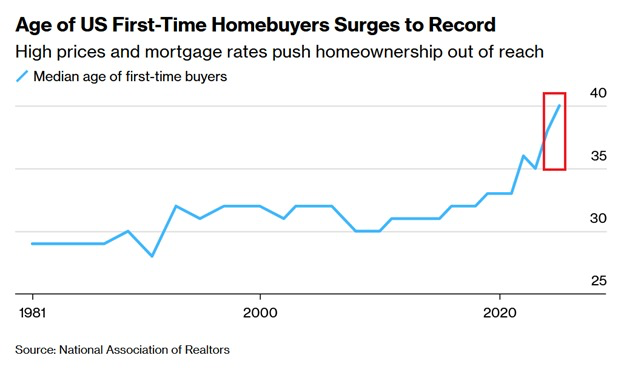
One consequence of this fact is that the average age of a U.S. first time homebuyer is crawling higher, in a creepy, disgusting manner:
Young adults are literally being priced out of housing.
Boomers have no idea.
First time homebuyers are saving up their down payment at a rate that is slower than the rise in home prices.
Boomers get to trade their paid-off home for another without so much as a blink of an eye.
It's why you hear so many stories of boomer parents giving a down payment to their millennial children so they can buy their first home.
That is the financial equivalent of "living in your parents basements."
Which, by the way, is another consequence of this adulterated economy.
On top of this, Boomers have loads of disposable income that is not going towards shelter. So, they are investing it and SPENDING it.
The Boomer Wealth Gap
The Boomer generation owns over half of all U.S. wealth, approximnately 52.4% in fact.
But they only account for 30% of all households.
In contrast, Millennials make up 37% of the households and own 11% of the wealth.
That is a major wealth gap that is wrecking havoc on society. But I won't dive deeply into that.
We've already illustrated why Boomers have this wealth: they have benefited from the tailwinds of inflation and monetary policy that favors asset-owners.
Instead of getting upset about the injustice of the system and blaming Boomers, I want to focus this newsletter on what comes next.
For years, I have wondered "what will Boomers do with all that wealth?"
Also, "How can I position myself to benefit from it?"
I stop to take a sip from my cappuchino. My toddler is reaching for her milk bottle on my desk and tips it over. I pick it back up and hand it to her, turn around to look out the window and take a moment to breath.
Staring out the window of my home office, I take a moment to appreciate what my family has. We bought this house from a Boomer in 2023. It was expensive but the house is very nice. We have a 4-bedroom 2,300 square foot, three car garage home in a fantastic neighborhood.
It's a great place to raise a family of four children. In fact, after thinking about it for a second, 8 out of 9 of our neighbors on our street are Boomers.
I appreciate how quiet they are and respectful.
I wish that everyone in my generation could be as fortunate.
So, what are Boomers spending their money on?
By all indication, they are living their best lives.
The Wall Stree Journal reports that Boomers are "wealthy, healthy, and driving a global travel boom."
It's incredible, really. For the first time in human history, an entire generation has the means and motivation to experience the world. It reminds me of this story I saw years ago:
https://www.npr.org/2022/05/13/1098735705/angelyn-and-richard-burk-are-spending-their-golden-years-on-cruise-ships
Angelyn and Richard Burk are two retired boomers who have decided to retire to...... cruise ships!
The couple now lives on Cruise ships over 120 days out of the year because its comparable to standard living costs.
Do Boomers love cruises? Yes, by and large they do.
I experienced this first hand while taking the family on a cruise to Alaska this summer. I took notice of many boomers: their dining habits, their shopping habits, their leisure habits.
The data shows that Boomers like to spend money on themselves:
45% of Boomers from this poll want to enjoy their money while they are still alive. This includes paying for their children to join them on trips that they want to do, but their kids can't afford because, ironically, boomers have "all the money."
I experienced this narcasssism in my argument with two boomers. They feel they have earned their wealth. After all, they earned it.
The Boomer Bucket List Portfolio
In earlier editions of this newsletter, I hinted at a new project I was working on. That project I have named "The Boomer Bucket List Portfolio."
This portfolio represents the opportunity that I see in earning some of that money that boomers will spend in their golden years.
It is my method of taking advantage of the wealth transfer that will occur as boomers approach the end of their retirements.
For the last several weeks, I have been researching stocks of companies that are poised to benefit from boomer spending.
This portfolio begins with the following investment thesis:
Boomers will splurge their spending on goods and services that bring them quality of life. This includes liesure activities and quality of life medicare care. Companies that offer a competitive edge and are not exposed to political risk are poised to earn profits from this spending.
Notably, companies that are exposed to Medicare represent too much risk for me. This is because I expect political pressure to mount against these companies and boomers will use their wealth and influence to fight against companies they percieve as taking advantage of them.
In short, I see far fewer complaints against a cruise ship company because the food was cold than a pharmecutical company because they raised the price of diabetes medication.
Here is an image of the top 5 stocks from my research, in terms of investment thesis fit. The entire research report includes 100 stocks and details of each company.
The portfolio focuses on four main themes of boomer spending:
- Leisure and hospitality
- Health and longevity
- Wealth management
- Senior living facilities
Let's take a look at specific trends:
- AARP’s 2026 travel work found that 86% of adults 50+ put travel in their top three discretionary priorities, ahead of dining and concerts. They take more expensive trips than younger cohorts. Cruising’s share of planned international trips rises from 15% at ages 50–59 to 28% at 70+.
- Functional and elective medical care that directly effects the ability to enjoy life include: Hearing (Original Medicare still does not cover standard hearing aids), Presbyopia and “I refuse to wear cheap readers," Premium cataract upgrades billed on top of a covered basic lens, Dental implants (insurance rarely covers the fixture).
- As Boomers draw down $84 trillion in generational wealth, BlackRock, Morgan Stanley, and Schwab are the primary custodians and advisors of that capital. Fee-based AUM models create durable, compounding revenue streams.
- Age-driven spending is measurable and proven (healthcare spending doubles after 65)
- The investment thesis sweet spot is now: currently Early-to-mid stage (30-40% through the cycle). Oldest Boomers turn 80 in 2026 (triggering senior housing wave). Next decade (2026-2036) = PEAK SPENDING PERIOD
I have now invested into the portfolio I created. Below is a screenshot of the current holdings. I will periodically update my newsletter subscribers about this portfolio's performance and changes.
Each of the holdings are being tracked in FASTGraphs. Here are the graphs for the top three positions, as example:
Booking Holdings ($BKNG)
Viking Holdings ($VIK)
Intuitive Surgical ($ISRG)
If you want to give FASTGraphs a try for yourself, sign up for a free trial and get a 25% discount on a paid subscription using this button and promo code AFFILIATE25.
Disclaimer: I may receive compensation from this affiliate link at no extra cost to you.
You can a copy of the full research report I created for this portfolio, just reply to this email and I will send it to you, free.
Last thoughts
Inflation is going to happen.
If you own assets, it can be your friend. If you do not, it will be your enemy.
The boomers have decades of help from inflation. Their wealth is going to go somewhere. My intent is to receive as much of that money as I can, by investing where I think they will spend it.
This newsletter is for educational purposes only and none of it is financial advice. I am not a licensed financial advisor. The stocks and companies discussed in this newsletter are positions that I have in my portfolio and are not recommendations.