Did you know that stocks represent the most accessible route to passive income for the majority of people?
It's simple. Open your brokerage account. Deposit funds. Buy a stock.
Now you're earning income passively.
Even if the company doesn't pay a dividend, you're still earning income if the company is turning a profit, otherwise referred to as cash-flowing.
The difference is that a company which does not pay a dividend is reinvesting that cash flow back into the business.
This is effectively the same as if you used your dividends to buy more of the company stock.
But understanding dividends and cash flow can be tricky.
I'm going to teach you using a case study that involves cyclical demand pulled forward.
This is the story of $POOL.
Pool Corp ($POOL) is a U.S. company that distributes, for lack of creativity, pool parts.
Normally, the pool business is quite relaxed.
But something interesting happened starting in 2020 and the effects are still being felt today.
Below is the FASTGraphs chart of operating earnings for POOL. Notice that from 2009-2019, Pool's earning grew steadily, averaging 19.9% CAGR. That is superb for any company.
Then, between 2020 and 2022, earnings surged like a tidal wave.
Long story short, the COVID-19 pandemic led to a surge of pool installations across the U.S. as people desired to add the amenity to their homes.
Pool's EPS rose from $6.40 to $18.70 in a span of three years.
This surge in demand was a classic case of demand-pulled-forward.
Once a house adds a pool it is unlikely to add another. This means that as homes were building pools rapidly, it was also reducing the number of homes without pools, rapidly.
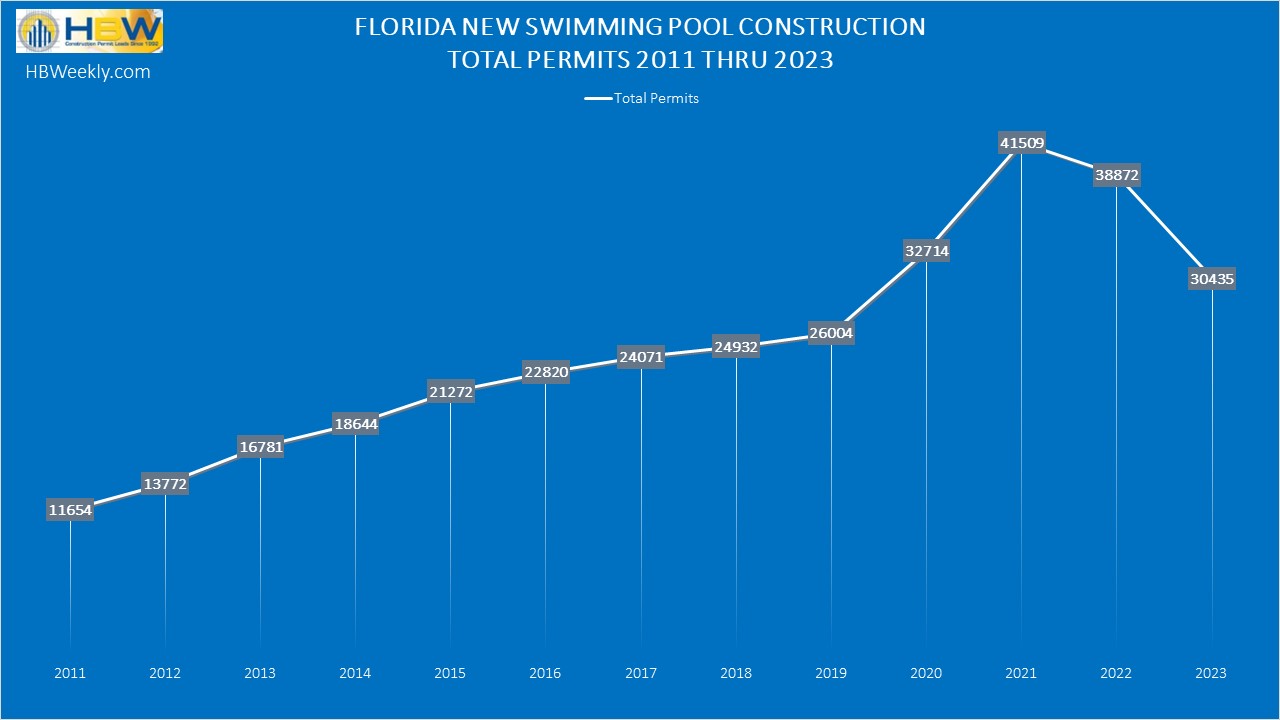
The chart below from HBWeekly shows how pool construction permits in Florida surged during those years. This represents the surge nationwide.
Today, pool construction permits have normalized below their pre-2019 trend. This is because of all that demand which will pulled forward.
As you can imagine, earnings for POOL have declined as the tide of permits recedes.
And so has the share price.
Last week, Pool released its Q2 earnings report. The company has finally shown 2 consecutive quarters of solid revenue growth, with +6.2% in Q1 and +2.15% in Q2.
Despite the demand pulled forward for new pool construction acting as a headwind to POOL, it now creates a very significant tailwind: maintainence.
POOL's revenue roughly breaks down as follows:
- New pool construction: 14%
- Pool remodeling, renovations, and upgrades: 22%
- Recurring maintenance and repair of existing pools: 64%!
Pool may have lost many potential customers for new pool construction, but they have gained a multitude of recurring maintainence customers.
Pools are expensive. Everyone knows this.
But pool owners have strong incentives to keep maintaining their pool. Here's why:
- Paying to maintain an in-ground pool is far cheaper than removing one
- Paying to maintain a pool is cheaper than repairing it for lack of maintainence
- A home's perceived value is greatly influenced by the condition of the pool
For these and many other reasons, Pool has grown its total addressable market for pool maintainence. And as these new pools age, as they are already 2-5 years old, they will require more repairs and renovation.
Analysts seem to agree. They are projecting stable earnings for POOL in 2027-2028 with 8% and 10% growth estimates.
Here's why Pool earns a spot on my watchlist:
If you want to beat the S&P 500 (and who doesn't?) then you have to buy companies that beat the S&P 500. Pool has an incredible track record of outperforming the S&P 500.
Over the previous 19 years, Pool has grown earnings at 12.4% per year compared to the S&P 500 at 8.32%. Pool has also grown its dividend at 15.08% compared to the S&P 500's 6.98%.
The fundamentals suggest that Pool's recent weakness is a classic case of demand-pulled-forward. Except in this case, demand pulled forward results in demand longevity.
This is a perfect case study in the importance of fundamentals, company quality, and understanding context.
I do own $POOL in my portfolio. This is not a recommendation. This lesson is for educational purposes only.
Give FASTGraphs a try for yourself. Start with a 7-day free trial and see what its all about. If you want to buy a subscription, use the promo code AFFILIATE25 for 25% off. It's my favorite tool.
Disclosure: the above link may earn compensation, which keeps this newsletter free, at no extra cost to you.